How Autonomous AI Workers Are Transforming IT Service Management
For more than a decade, ServiceNow has been the backbone of modern IT service management (ITSM).
It brought structure to IT operations through standardized workflows, ticket routing, and centralized service management.
But today, something new is happening inside enterprise IT.
A growing share of tickets no longer require humans.
Not because they are unimportant - but because they are repetitive, rule-based, and fully automatable.
This is where the AI Worker for ServiceNow enters the picture.
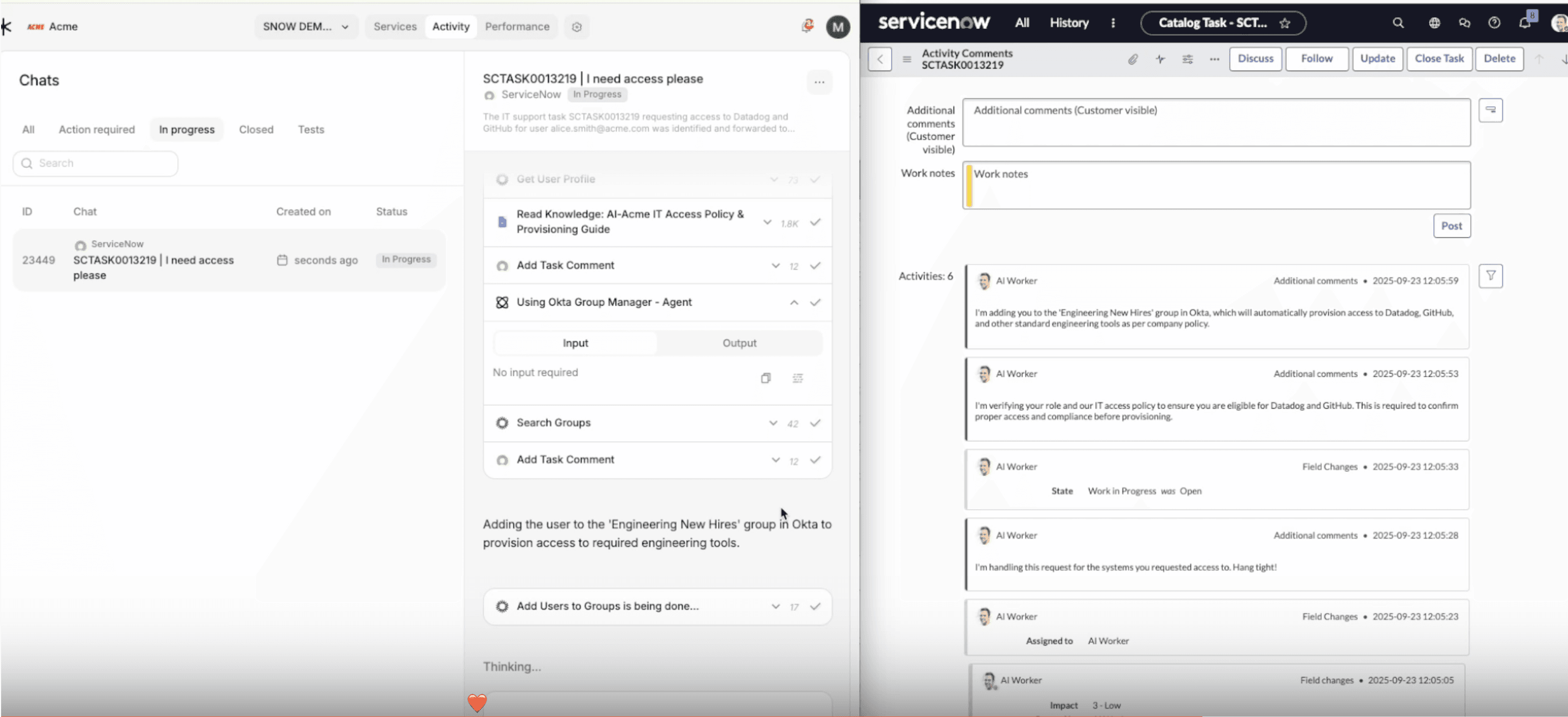
Instead of simply routing tickets or assisting agents, AI Workers can now receive requests, make decisions, execute actions across enterprise systems, and close tickets autonomously.
For IT teams facing rising ticket volumes and pressure to do more with fewer resources, this represents one of the most important shifts in IT operations since the introduction of ITSM itself.
Why ServiceNow Automation Is the Next Major IT Transformation
Most IT service desks today still operate in a similar way.
A request comes in.
It gets categorized.
It gets routed.
An IT agent investigates the issue.
Then they perform the required action in another system.
Finally, they update the ticket and close it.
The ticketing system orchestrates the workflow, but the work still happens manually.
A typical process might look like this:
ServiceNow ticket
→ Manager approval
→ IT agent opens Okta or Entra
→ Assigns permissions or groups
→ Updates the ticket
→ Closes request
While structured, the process still consumes significant time and resources.
And many of these requests are highly repetitive.
Examples include:
Application access requests
Distribution list updates
Password resets
Employee onboarding tasks
Software provisioning
Group permission changes
In many enterprises, these types of requests represent 20–40% of all IT tickets.
Which means a large portion of the service desk workload is not troubleshooting.
It is execution.
From Ticket Routing to Autonomous Execution
Traditional automation tools inside ServiceNow attempt to solve this through:
Workflow automation
Rules and triggers
Integration scripts
RPA
But these approaches often struggle with real-world complexity.
They require:
heavy configuration
constant maintenance
brittle workflows that break when conditions change
AI Workers represent a fundamentally different approach.
Instead of hardcoding workflows, AI Workers understand requests, evaluate policies, and perform tasks dynamically.
This allows them to operate across multiple systems without rigid workflows.
An AI Worker for ServiceNow can:
Receive the ticket
Understand the intent
Check policies
Request approvals if required
Execute the task
Update the ticket with a full audit trail
All without human intervention.
The ticket becomes a trigger for autonomous work.
What an AI Worker for ServiceNow Actually Does
An AI Worker integrated with ServiceNow acts as a digital IT operator.
It connects to the enterprise systems where the actual work occurs.
This typically includes:
Identity systems
Okta
Microsoft Entra ID
Active Directory
SaaS platforms
Salesforce
Google Workspace
Slack
Figma
Atlassian
Infrastructure tools
AWS
Azure
Kubernetes environments
Collaboration platforms
Teams
Slack
Email systems
When a request arrives, the AI Worker can take action across these systems directly.
Instead of assigning a ticket to an agent, the system simply completes the task.
Example: Automating Access Requests in ServiceNow
One of the most common IT tickets is application access requests.
A typical request might be:
“Can I get access to Salesforce?”
In a traditional process, this might require several steps.
Manager approval.
An IT agent manually assigning permissions.
Updating the ticket.
Closing the request.
With an AI Worker for ServiceNow, the flow becomes dramatically simpler.
The worker:
Receives the request.
Understands the requested access.
Checks policy rules.
Requests approval if required.
Assigns permissions in Okta or Entra.
Writes the execution details back to ServiceNow.
Closes the ticket.
All actions are logged and auditable.
From the employee perspective, the request is resolved in minutes instead of hours or days.
Why CIOs Are Looking at AI Workers Now
Several macro trends are driving interest in AI Workers for ServiceNow environments.
1. Exploding Ticket Volumes
As organizations adopt more SaaS applications, IT service desks face increasing demand.
Every new application introduces:
new access requests
new permission changes
new support tickets
Without automation, IT headcount must grow proportionally.
AI Workers allow organizations to scale service capacity without scaling headcount.
2. Pressure to Improve Employee Experience
Slow service desks directly impact productivity.
Waiting hours or days for simple requests like application access can block employees from doing their jobs.
AI Workers dramatically reduce resolution times.
Tasks that previously required manual handling can now be completed almost instantly.
3. IT Talent Shortages
Many organizations struggle to hire experienced IT support staff.
By automating routine tasks, AI Workers allow IT teams to focus on:
infrastructure reliability
cybersecurity
complex troubleshooting
strategic initiatives
4. Cost Efficiency
Service desk operations represent a major operational cost.
When AI Workers handle routine tickets autonomously, organizations can significantly reduce operational overhead.
AI Workers vs Traditional IT Automation
The concept of automation in IT is not new.
But AI Workers represent a major leap forward compared to previous approaches.
Traditional automation relies on:
rigid workflows
static rules
scripted integrations
AI Workers introduce:
contextual understanding
policy reasoning
adaptive execution
natural language interfaces
cross-system orchestration
Instead of building hundreds of brittle workflows, organizations deploy autonomous operators that can adapt dynamically.
Security and Governance Considerations
Automation in IT always raises an important question.
Is it safe?
Modern AI Workers are built with enterprise governance in mind.
Key safeguards include:
Policy enforcement
The AI Worker checks defined policies before executing tasks.
Approval workflows
Sensitive requests can still require human approval.
Audit trails
Every action is logged and written back to ServiceNow.
Permission boundaries
The AI Worker operates only within predefined system permissions.
This ensures automation does not compromise security or compliance.
The Future of ServiceNow: AI Workers Running the Service Desk
The introduction of ServiceNow transformed IT operations by introducing structure.
The introduction of AI Workers is transforming IT operations again by introducing autonomy.
Instead of service desks focused on routing tickets, the future will look very different.
Tickets will increasingly trigger automated execution rather than manual handling.
AI Workers will become the first responders to service requests.
Human agents will focus on the exceptions.
Over time, this model allows organizations to build self-driving IT operations.
Final Thoughts
ServiceNow remains one of the most powerful platforms for managing enterprise service operations.
But the way work happens inside those tickets is changing rapidly.
AI Workers bring the missing layer: execution.
They do not replace ServiceNow.
They transform what happens after the ticket is created.
Instead of routing work to humans, the system can now complete the work autonomously.
For organizations looking to reduce IT workload, improve employee experience, and modernize service operations, AI Workers represent the next major evolution of ITSM.
About ai.work
ai.work is building the AI Worker platform for enterprise service operations.
Our AI Workers integrate directly with ServiceNow and the enterprise technology stack to autonomously execute service requests across identity systems, SaaS platforms, and infrastructure tools.
The result is faster resolution times, reduced service desk workload, and a dramatically improved employee experience.